
From the ZBW to the EOSC
ZBW creates research data infrastructures that are interoperable at European level

The European Open Science Cloud (EOSC) aims to make research data in Europe easier to find and use. The key to this is not a central archive, but the interconnection of many existing services via common rules and technical interfaces. This is precisely what the ZBW is working on. As part of the National Research Data Infrastructure (NFDI), it develops and operates building blocks that make research data from the field of economics visible across Europe, thereby demonstrating how national infrastructure work can be translated into the European federation.
The European Open Science Cloud (EOSC) follows a clear principle. Research data should become easier to find and use in Europe, even across national and institutional boundaries. To achieve this, not all data is moved into a single centralised system. Instead, it remains where it is generated, described and published. They become visible and usable across Europe because the participating institutions agree on common rules. These are: uniform standards for data descriptions, reliable technical interfaces, and persistent and unique identifiers.
For the ZBW, this logic guides its actions. As an infrastructure organisation, the ZBW organises access to economic literature and is increasingly applying this principle to research data as well. Within the framework of the NFDI, the ZBW is implementing the provision of this data within the EOSC in line with clearly defined use cases. This demonstrates how national infrastructure components can be integrated step by step into the European infrastructure. By 2025, the ZBW will have established the technical and organisational foundations for this, which are compatible at European level. Data will be described and made accessible in such a way that it can be found across platforms; datasets will be assigned stable identifiers; and search and re-use pathways will be implemented so that they also function outside the ZBW’s own portal.
NFDI as a national framework
The NFDI is the national framework for the development of research data infrastructures in Germany. It operates through subject-specific consortia, which gather requirements from their respective communities and translate them into concrete offerings. In the field of economics, these are BERD@NFDI for business administration research and NFDI4Society, formerly known as KonsortSWD, for data repositories relevant to economics. In both subject-specific consortia, the ZBW is the central infrastructure partner, supporting developments since the start-up phase and implementing them on an ongoing basis.
For the ZBW, this means that, as an infrastructure partner within the consortia, it contributes its technical expertise in a holistic manner – from identifying needs, through design and implementation, to the operation and further development of research data infrastructures. This commitment is a key part of its contribution and highlights the important role played by the ZBW. The ZBW translates technical requirements into concrete software and service development and ensures reliable operation.
A research data repository compatible with European standards
The focus in 2025 was on a use case from the BERD consortium, which demonstrates how the NFDI’s work feeds into the EOSC: the operation of the BERD Data Portal for the business research community. Business researchers can now store, publish and share their data with their community via this data portal. A key component is the assignment of a persistent identifier, a Digital Object Identifier (DOI). The DOI makes datasets citable, thereby enabling data to be persistently linked to publications.
In terms of content, the Data Portal addresses specific needs within the field of economics, particularly in areas where data is not available in traditional tabular formats. These include, for example, text-based datasets and other unstructured data collections. In addition, data collections from other sources are curated and made available in such a way that they can be searched for by the academic community in one central location – a significant simplification in research practice. The Data Portal is not merely a ‘repository’, but supports the discovery, classification and use of data.
Why ‘data description’ is infrastructure work
Whether data can be found and used depends heavily on how it is described. Researchers themselves have the best insight into this. That is why, in 2025, work on so-called metadata – that is, the information that describes a dataset and makes it discoverable – was a central part of infrastructure work.
The ZBW focuses on two aspects here. Firstly, it is about providing a simple and straightforward submission process – in other words, usability. This means that input forms and help sections have been designed so that researchers can enter the most important details without requiring specialist knowledge. Secondly, quality assurance prior to publication plays a key role. Before a dataset is published, so-called data stewards check the completeness and basic quality of the information.
In addition, in 2025 the ZBW gathered systematic feedback from practitioners through extensive usability studies. These studies examined whether typical tasks such as uploading data, finding data or reusing data actually work, and where there is room for improvement.
The focus of the ZBW’s work here is therefore on bringing together technology and impact. After all, European discoverability is not achieved solely through rules and standards, but also by describing data in such a way that it can be used in the long term and by machines – even outside one’s own portal.
Connecting to the EOSC not through relocation, but through interoperability
The path taken by the NFDI as Germany’s national contribution to the establishment of a European data space for research data follows the federated principle of the EOSC. For example, the datasets remain in the BERD Data Portal, the central repository of BERD@NFDI. They become visible across Europe by feeding their descriptions into overarching search and discovery systems. Technically, this is achieved through services that consolidate descriptive metadata from numerous sources. OpenAIRE plays a central role in the EOSC’s search contexts because it retrieves metadata from repositories and bundles it into a unified search index. OpenAIRE is a European platform that collects and links metadata on scientific publications, research data, software and projects.
For the ZBW, this means that research data metadata must be made available in suitable formats and that interfaces must be implemented in such a way that data collection functions reliably. The contribution to the EOSC therefore does not consist of ‘moving’ data, but rather in ensuring interoperability – through clear data descriptions, reliable technical access and traceable mappings between local and cross-platform formats.
Sustainable infrastructures underpin the EOSC
For the EOSC to function as a federated research data infrastructure, different systems must work together on a common level. This gives rise to a typical tension: local systems often provide very detailed data descriptions, whereas at European level, standardisation across many sources is required to enable a joint search. This may mean that not every piece of information is visible in the same way everywhere.
This is precisely where part of the ZBW’s key work lies. Interoperability does not arise automatically, but through the process of translating between subject-matter logic and technically agreed standards. This means that, in order to put European objectives into practice, we need not only permanently operated platforms and services, but also standards, mandatory interfaces and quality processes.
Greater visibility, less duplication of effort, better cooperation
The impact of the EOSC connection is evident on several levels. For users across Europe, datasets become discoverable via cross-platform search portals, even if the BERD Data Portal – developed by ZBW’s software developers – was not previously known to them. For researchers, publishing data via the repository means greater visibility, without the need to store datasets in additional systems in order to increase re-use. And for the system as a whole, the technical integration creates robust working relationships between services and teams. Cooperation thus becomes an integral part of day-to-day operations.
The integration of the BERD Data Portal with the EOSC is also significant because it serves as a pilot for a replicable approach: namely, the integration of research data repositories with the EOSC or other discovery systems. In this way, the ZBW fulfils a dual function. It brings its own expertise and services into the European context and provides a procedural model that other institutions can adopt.
Guiding principle: FAIR – only robust when the right infrastructure is in place
The FAIR principles form the guiding framework for handling research data. FAIR means that data should be findable, accessible, interoperable and reusable. The aim is for data not only to be understandable to humans, but also to be processable by digital services – for example, for searching, linking, analysis or re-use in other contexts.
It is crucial to recognise that FAIR is not achieved simply by researchers ‘describing data well’. FAIR only becomes robust when the appropriate infrastructure is in place and is operated on a long-term basis. This includes stable, persistent identifiers (such as DOIs), so that datasets remain uniquely referenceable even as technical environments change. Equally important is machine-readable metadata that provides context, for example on the methods employed, the variables used, licences or access conditions. Only when such information is available in a structured format can search engines reliably locate datasets and help users assess their suitability.
Interoperability also requires common interfaces and exchange formats so that repositories, catalogues and other services can automatically adopt and merge data descriptions. This highlights that FAIR is also a matter of translation. Local, subject-specific levels of detail must be mapped in such a way that they are preserved in overarching European search and discovery systems.
Ultimately, the implementation of the FAIR principles relies on a reliable infrastructure: clear processes for submission and review, versioning and citability, documented responsibilities, and measures to ensure the long-term availability of datasets all help to build trust. In this sense, FAIR is not merely a label for datasets, but the interplay of shared rules, technology and operational practices. And this is precisely where infrastructure work, such as that carried out by the ZBW, comes into play.
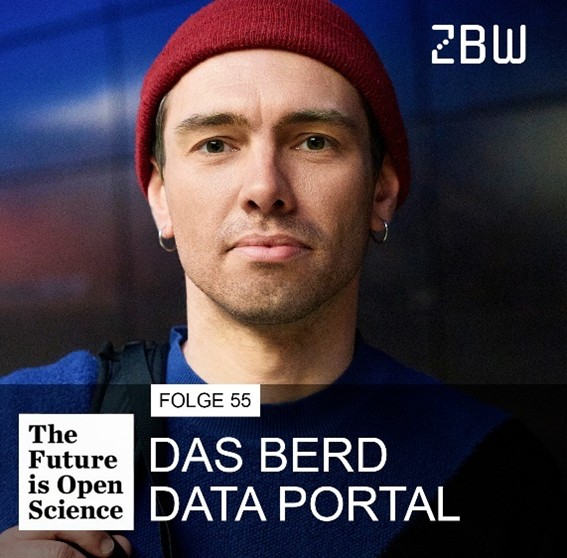
Listening tip:
In episode 55 of our podcast ‘The Future is Open Science’, Janne Jensen, a software developer at the ZBW, talks about his work on the BERD Data Portal and the opportunities that the development of the Web of FAIR Data presents for researchers.
URL: podcast.zbw.eu/fos/2025/12/23/fos-55-das-berd-data-portal
This text was written in April 2026.
This text was translated on 2 July 2026 using DeeplPro.